
The Long Way Home
The Extraordinary Life and Legacy of Second Lieutenant
David Leslie Bowman

Second Lieutenant David Leslie Bowman was the last man left aboard Paper Doll as the crippled B-24 descended toward the Romanian countryside.
From his position inside the glass nose of the bomber, Bowman could feel the aircraft shudder beneath his body. The steady vibration of four engines had given way to the uneven, sickening pull of two. Somewhere behind him, metal groaned under the strain. Wind screamed through the damaged airframe, carrying with it the sharp smell of fuel, hot machinery, and smoke.
Through the curved glass, the earth seemed to rise toward him.
Fields and roads slowly sharpened into view. Rooftops appeared in the distance. Western Romania was no longer a landscape far below, but something coming closer with every passing second.
The right wing had been badly damaged by antiaircraft fire and was beginning to fail. The rest of the eight-man crew had already abandoned the aircraft, disappearing one by one through doors and bomb-bay openings into the freezing air below.
Bowman was wedged beneath and ahead of the cockpit in the navigator-bombardier’s position, surrounded by maps, instruments, oxygen equipment, and the heavy layers designed to keep him alive at altitude. Now, everything around him seemed to be working against him.
His flight gear restricted his movement. Radio wires and heating lines crossed his body, tethering him to the aircraft. There was no door beside him and no easy path out of the nose.
His only escape was through the front wheel well.
When the landing gear dropped, it opened a narrow route through the belly of the bomber. Beyond it was nothing but open air and the ground rushing closer.
Bowman pulled himself toward the opening as the aircraft lurched beneath him. He lowered his head and tried to roll through the wheel well, but the wires caught across his body and snapped tight, dragging him backward into the plane.
For a moment, he was trapped inside again.
The wind hammered against the opening. The damaged bomber trembled around him. He was running out of time. Cold air and exhaust filled the cramped compartment as precious seconds disappeared.
Bowman gathered himself, forced his body toward the opening, and tried again. This time, he committed fully to the motion. He rolled forward, the cables pulled tight, and then, all at once, they tore loose.
The roar of the bomber gave way to the violent rush of open air.
Bowman dropped through the wheel well and fell away from the aircraft. Above him, Paper Doll continued on, wounded and unmanned, trailing its noise and smoke across the Romanian countryside.
For several seconds, there was only the fall.
The wind tore at his clothing. The cold struck his face. The earth shifted beneath him as he reached for the parachute mounted to his chest.
He found the cord and pulled.
The canopy opened with a sudden, brutal snap, wrenching his body upward against the harness. Then, almost as quickly, the world slowed.
The bomber drifted away from him. Its roar faded into the distance, replaced by the quieter sound of wind moving through the parachute above.
Below, a small Romanian town came into focus. Red roofs clustered along narrow streets. Fields stretched beyond them in long, uneven lines. At the center of the town stood a church with an onion-shaped dome.
Bowman drifted toward it.
The branches of a nearby tree caught his parachute, leaving him suspended beside the church. As a deeply religious man, landing there must have carried its own strange sense of providence.
Then voices rose from below.
Two Soviet soldiers approached with submachine guns raised.
Bowman had landed in territory controlled by an allied army, but that did not mean he was safe.
As the war neared its end, Soviet troops had heard stories of desperate German soldiers stealing American uniforms in hopes of avoiding capture.
Bowman knew only one Russian word that might help him.
“Amerikansky,” he called down.
American.
The soldiers brought him down from the tree and took him into custody. The rest of the surviving crew was gathered as well, but for nearly a day, the Soviets trusted none of them. American uniforms were not enough. Neither were their explanations. The soldiers needed to know that the men standing before them were truly downed American airmen and not Germans attempting an escape.
Eventually, the evidence began to add up. Bowman had American dog tags. His papers checked out. Perhaps most convincingly, the young man from Seattle could not speak a word of German.
Once their identities were confirmed, suspicion gave way to an almost surreal welcome.
The town’s mayor and the captain of the Soviet garrison arrived carrying a tub of ice cream and a bottle of vodka—an apology for the detention and a celebration of the unexpected allies who had fallen from the sky.
Together, the Americans and Soviets raised their glasses in a toast to Churchill, Roosevelt, and Stalin.
Only hours earlier, Bowman had been trapped inside a falling bomber.
Now he was eating ice cream and drinking vodka with the Red Army.
It was another turn in a life that seemed to run on equal parts luck, guts, and the strange hand of fate.
But stories like this do not survive on luck alone. They survive because someone remembers them, asks the right questions, saves the fading paperwork, and understands that a family story can become part of something larger.
For David Bowman, that person would be his grandson.


The Keeper of the Story
More than eight decades later, David Bowman’s grandson, Sean Lorentzen, sits surrounded by a very different kind of machinery.
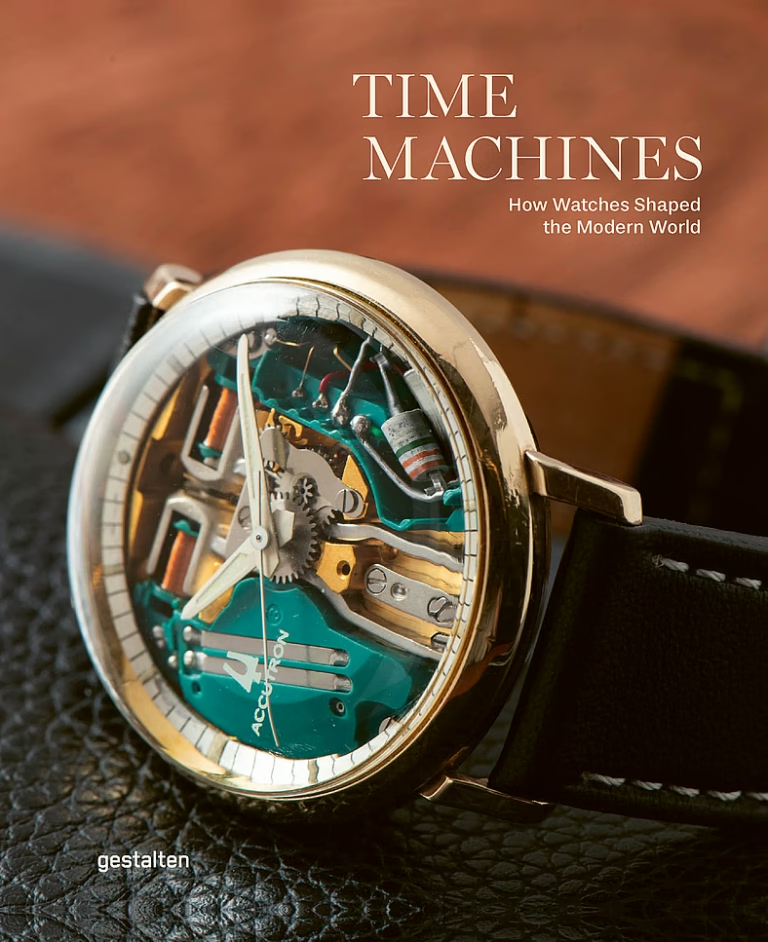
Sean is the senior editor of aBlogtoWatch, where he manages an editorial team and writes about the design, history, and culture of watches. He is also the author of Time Machines, his first book devoted entirely to timepieces, along with several books exploring the automotive world.
Before watches became the center of his career, Sean worked as a journalist and public-relations professional in the car industry, representing names such as Lamborghini, McLaren, Bugatti, and Lotus.
His journey into watches grew naturally from that world. Both cars and timepieces appealed to him as mechanical objects shaped by engineering, design, and personality. What began as a hobby nearly 15 years ago eventually became his profession.
Yet for Sean, a watch has never been only a machine.
“They’re very emotional machines,” he explains.
A watch is carried through the moments that define a life. Through war, exploration, achievement, loss, and the quiet days that follow. Over time, it becomes connected not only to a single moment, but sometimes to an entire lifetime. When it passes from one generation to the next, it carries something of the person who once wore it.
That understanding feels especially personal when Sean speaks about his grandfather.
Bowman’s original wartime possessions were largely lost over the years. There is no watch from his wrist that Sean can hold and wind. What remains instead are documents, family memories, a fragment of Paper Doll recovered from the Romanian field where it fell, and the stories Bowman entrusted to his grandson.
Sean has become their keeper.
He remembers his grandfather not simply as the young navigator-bombardier who survived a falling B-24, but as the moral center of his family. A husband, father, and good man whose wartime service was only one chapter in a life that lasted nearly a century.
“I think he’d probably be prouder of being a husband and a father and a good person than a war hero,” Sean says.
Perhaps that is why Sean’s place in the watch world feels connected to this story, even without a timepiece belonging directly to Bowman. His career is built around objects that carry memory forward, and his grandfather left him something even more enduring: a life worth remembering and the responsibility to make sure it is not forgotten.
When Sean tells Bowman’s story, he is doing what the most meaningful heirlooms have always done. He is carrying a life from one generation into the next.
To understand the life he is preserving, however, we have to return to the beginning—to Italy, to the glass nose of a B-24, and to a crew of young men asked to carry responsibilities far beyond their years.

The Old Men
David Leslie Bowman entered the United States Army Air Corps during World War II and trained as a navigator-bombardier aboard a B-24 Liberator. He served with the 781st Bomb Squadron of the 465th Bomb Group, Fifteenth Air Force, spending much of the war stationed in Italy.
From there, his crew flew missions over Germany, Austria, Hungary, Romania, and Czechoslovakia.
The Fifteenth Air Force had been created to carry the Allied strategic bombing campaign into southern and eastern Europe. Operating primarily from bases in Italy, its bombers could reach industrial centers, oil facilities, rail networks, and aircraft factories that were difficult to strike from England. For crews like Bowman’s, that meant long missions over the Alps and deep into enemy territory, often beyond the reach of an easy emergency landing or a guaranteed path home.
The responsibility placed on them was enormous.
The men carrying it were barely men at all.
Bowman was 21 years old and the second-oldest member of his crew. The pilot was 22, old enough to earn the nickname “old man.” Most of the others were still teenagers.
They climbed into an aircraft that offered little comfort and even less forgiveness.
The B-24 was not pressurized. The Liberator was built for range and payload, not comfort. At operating altitude, temperatures could fall far below freezing, forcing crews to rely on heated flight gear and oxygen while remaining exposed to enemy fighters and antiaircraft fire. Bowman’s position in the transparent nose gave him the view he needed to navigate and aim the bombs, but it also placed him at the very front of the aircraft, separated from the most obvious escape routes.
Bowman sat in the nose, looking down at Europe through glass.
As navigator, his job was to find the target and guide the aircraft home.
As bombardier, his responsibility was much heavier.
For much of her life, even his daughter knew him only as a navigator. The truth that he had also been the man behind the bombsight emerged much later.
Bowman was deeply religious. He understood the necessity of the missions, but necessity did not make their consequences easy to carry. Sean believes the knowledge stayed with him: when the moment came, his was the hand that pressed the button.
Like many members of his generation, Bowman did not bring every memory home.
Some stories were shared only with other men. Some surfaced years later. Others were never spoken aloud at all.
Humility was part of that silence, but also the survival.
“A lot of these guys never really processed what they went through,” Sean explains. “You just don’t talk about it.”
They completed the mission, returned to their families, and tried to build lives large enough to hold what had happened.
Fortunately, some of Bowman’s stories survived.
Placed beside one another, they reveal a life repeatedly balanced on the narrow edge between chance and choice. One of the clearest examples began high above Austria, where a layer of clouds turned a bombing mission into a race against fuel, ice, and time.
The Bombs Frozen Above Austria
On one mission over southern Austria, the sky above Bowman’s squadron was clear, but the world below was not.
A solid blanket of clouds concealed the ground, covering the target beneath them. At that point in the war, bombardiers were required to visually confirm their targets before releasing their payloads. Coordinates alone were not enough. Bowman had to see the target through the bombsight.
The squadron descended from roughly 30,000 feet toward bombing altitude.
The B-24 dropped into the cloud layer, where the bright sky vanished and moisture streaked across the glass. For a few moments, the crew could see almost nothing beyond the aircraft.
Then they broke through.
Other bombers found their targets, released their payloads, and turned south for Italy.
Bowman’s target remained hidden.
His crew climbed again, carrying the full weight of the bombs toward a secondary target farther inside Austria.
Every extra mile mattered. A fully loaded B-24 burned more fuel, and the longer the payload remained aboard, the narrower their chances of returning home became.
The crew descended again.
This time, the target appeared beneath the clouds.
Bowman aligned it through the bombsight, placed his finger on the release, and pressed.
Nothing happened.
He tried again.
Still nothing.
The repeated climbs and descents through the clouds had allowed moisture to collect inside the open bomb bay. At altitude, it froze around the payload and locked the release mechanisms solid.
Thousands of pounds of explosives were trapped inside the bomber, and someone had to clear the ice.
The job fell to a 19-year-old waist gunner.
With a ball-peen hammer in hand, the young airman crawled into the bomb bay and onto a catwalk barely wider than a foot. Beneath him, the doors stood open to tens of thousands of feet of empty air.
Cold wind rushed through the aircraft. The bombs hung inches from his body. Each step had to be placed carefully against the trembling metal.
Then he began to swing.
The hammer struck ice again and again, breaking it away from the 500-pound bombs while the aircraft continued through enemy territory.
By the time the mechanisms were finally clear, the crew had already passed its secondary target.
They were still carrying the bombs, and the fuel was running low.
They could not fly the payload all the way back to Italy. They could not simply release it over the towns and farms below. The pilot turned to Bowman.
He was the navigator. He had the map.
They needed somewhere to put the bombs, and they needed it quickly.
Bowman searched the landscape beneath them. Among the mountains, he found a small lake beside an Austrian village.
It was not a military target. It offered no strategic value. But it gave them open water and the best chance of releasing the weight without killing anyone. Bowman chose the lake.
The bomber banked toward it.
Below, the water must have appeared calm and impossibly small against the surrounding mountains. Bowman watched through the glass as it moved beneath the aircraft.
The bomb-bay doors remained open, and thousands of pounds of explosives fell from the plane.
For several seconds, there would have been nothing but the empty space between the aircraft and the water.
Then the lake erupted.
Water and smoke rose into the air beneath them as the B-24, suddenly lighter, turned south and began the long flight home.
Bowman had been lucky enough to find the lake before the fuel ran out.
But luck alone had not made the decision.
It took judgment to recognize the opening and conscience to choose it.
The bombs still fell. The water still exploded beneath them. But in a war built around destruction, Bowman had found one place where his payload might land without taking a life.
He could not have known that the choice would return to him ten years later.
The Girl at the Lake
By 1955, the bomber was gone, the war had ended, and David Bowman was living in Denver, Colorado, where he ran a carpet, tile, and flooring business.
One afternoon, he met with a wholesaler to discuss inventory for the coming year. Because the appointment fell around lunchtime, the men decided to continue their conversation at a restaurant. The wholesaler brought his wife.
The setting could hardly have been further removed from the war. There were no engines, oxygen masks, or maps spread beneath a glass nose. Only menus, conversation, and the ordinary sounds of a restaurant in postwar America.
As they spoke, Bowman learned that the woman was German. She had met her American husband during the war and followed him home to the United States.
The conversation drifted toward those years, and Bowman mentioned that he had served in the Army.
He did not mention the B-24.
He did not mention the bombsight.
He did not mention the lake.
But as the woman began telling her own story, he felt an odd sense of familiarity with her account.
She had grown up in Berlin. As the war turned against Germany and the bombing intensified, her parents decided to send her away. They chose a remote village in the Austrian Alps, where her grandparents lived beside a small lake. There would be no factories there. No rail yards. No reason for American bombers to come. They believed she would be safe.
Then one day, she told the men across the table, an American bomber appeared over the mountains and dropped its bombs into their lake.
Bowman sat silently. The mission she remembered was his.
The lake her parents had chosen as a place of refuge was the same lake Bowman had chosen because he believed no one would be harmed. From the air, it had been an act of restraint. From the ground, it had been an explosion large enough to remain in a young girl’s memory for the rest of her life.
Ten years after the bombs fell, the man who released them and the girl who watched them land had somehow arrived at the same table in Denver.
Bowman said nothing.
Perhaps he could not find the words. Perhaps the truth would have offered neither of them peace. Perhaps, after carrying so much of the war in silence, this was simply one more story he chose to keep. Whatever the reason, he let her finish.
It was an encounter too precise to feel ordinary.
There was nothing frightening or sorrowful in the way their paths crossed, only a quiet sense of serendipity, as though life had briefly revealed the invisible threads connecting one person’s choices to another person’s story.
Perhaps nothing we do exists entirely in isolation. Each of us carries a purpose, leaves an impact, and contributes to a legacy whose full shape we may never live to see.

The Red Tails Between Them
The connection between Bowman’s past and the present did not end at that restaurant table.
Years later, his grandson Sean met Jackie, the woman with whom he would begin building a life of his own. As their relationship deepened, they began sharing family histories. Names, photographs, military records, and half-remembered stories that often sit quietly in boxes until someone decides to look closer.
Neither of them expected those histories to meet. As Sean and Jackie compared their family records, they discovered that her great-uncle had served as a Tuskegee Airman.
During World War II, the Tuskegee Airmen’s red-tailed P-51 Mustangs frequently escorted the heavy bombers of the Fifteenth Air Force. To the young men inside the B-24s, those fighters were more than a welcome sight. They were protection against enemy aircraft, a shield of speed and firepower circling vulnerable bombers as they crossed hostile skies.
Bowman remembered the Red Tails well. According to Sean, their fighter cover saved his grandfather’s life more than once. Then Sean and Jackie uncovered something neither family had known. Her great-uncle and his grandfather had flown together. While Bowman sat inside the glass nose of a B-24, navigating his crew across Europe, Jackie’s great-uncle had flown above and around him, guarding the bomber from the cockpit of a P-51.
They may never have spoken. They may never have known one another’s full names or imagined the lives waiting for them beyond the war. Yet, for a brief stretch of sky, their fates depended on each other.
Then the war ended. Both men returned home, built families, and lived out the years they had helped preserve for one another. Generations later, those families found each other again.
The discovery feels almost too carefully arranged to dismiss as chance. Two men crossed paths above Europe without knowing that their descendants would one day meet, fall in love, and uncover a connection that had been waiting between their families for decades.
Sean called it another beautiful piece of kismet.
Like the encounter with the girl beside the Austrian lake, the discovery offered another reminder that the full meaning of our lives is rarely visible while we are living them. We move through the world believing our choices belong only to us, unaware of how they may reach into the lives of strangers or ripple through generations not yet born.
Perhaps serendipity is simply the moment when we are finally allowed to see a connection that was there all along.
We are shaped by people whose names we may never know. We are protected by sacrifices we may never witness. Through the lives we build, the families we love, and the stories we leave behind, we may become part of someone else’s legacy without ever realizing it.
But before either of those families could meet again, before Sean or Jackie could be born, David Bowman first had to find his way home.
And in Seattle, the woman waiting for him had already been told that he never would.
The Ghost at the Door
While Bowman was being questioned by Soviet soldiers and moved through Romania and Hungary, his young wife was waiting thousands of miles away in Seattle.
They had married shortly before he shipped out. Their life together had barely begun before the war separated them, leaving behind promises, photographs, and plans for a future they had not yet been given the chance to build.
Then came the knock at the door no military family ever wanted to hear.
Officials arrived carrying a folded American flag and the news that Bowman’s B-24 had been shot down. He was missing and presumed dead.
There was no body to bring home. No grave to visit. No final goodbye.
Only the flag and the unbearable absence of certainty.
For roughly two months, she began the impossible work of accepting that the man she had just married was gone. She grieved not only for her husband, but for the entire life they were supposed to have. The home they had not yet built, the family they had not yet raised, and all the ordinary years that had been taken before they could begin.
Then, one day, there was another knock. She opened the door and found David standing on the other side.
Alive.
After months apart and weeks of believing him dead, her husband had returned to the same doorstep where the news of his death had been delivered. He must have looked almost like a ghost—a man already mourned, suddenly standing in the daylight.
The Army granted Bowman two weeks of leave in San Francisco. For the young couple, it became the honeymoon the war had denied them, a brief chance to reclaim the beginning of their marriage before history called him away again.
Germany had surrendered, but the war in the Pacific continued.
Bowman and much of his crew were reassigned to fight Japan and placed aboard a troop ship preparing to leave San Francisco Harbor.
The ship was scheduled to depart on August 9, 1945. That morning, the atomic bomb was dropped on Nagasaki. The troop movement was halted. Japan surrendered soon afterward, and the man who had already returned from the dead was finally allowed to come home for good.
Luck had opened the door once more. But what followed was not luck.
David and his wife would share approximately 75 years together, transforming the future she had once believed lost into a long marriage, a family, and a life of service to others.
The war had given Bowman a remarkable story. What he did afterward gave that story meaning.
The Legacy He Chose
Very little of Bowman’s wartime equipment remains.
His flight jacket, medals, service pistol, and other keepsakes were stolen from his home during the 1950s. But his family still possesses a fragment of Paper Doll, recovered from the field in Romania where the bomber came down. The piece of metal survived. So did the stories.
The frozen bombs above Austria.
The girl beside the lake.
The engines failing over Linz.
The second attempt through the wheel well.
The soldiers with their guns, followed by vodka and ice cream.
The wife who had already been handed a flag, opening her door to find her husband standing there.
The Tuskegee Airman whose family would one day become connected to his own.
These moments are extraordinary because of how narrowly they unfolded.
A few seconds later. A few miles farther. A different lake. A different restaurant.
The entire story might have changed.
But a legacy is not created by good fortune alone. It is created by what a person does with the life fortune leaves in their hands. David Bowman could not control the cloud cover, the frozen mechanisms, the flak, the failing wing, the Soviet soldiers, or the date his troop ship was scheduled to leave. What he could control was the decision in front of him.
Try again.
Make it work.
Keep moving.
Get home.
Become the kind of man whose example would still guide people long after he was gone.
Luck helped David Bowman survive the war. Guts brought him home. But the goodness, service, and character that followed were choices he made for the rest of his life. That is how he created his legacy.
And perhaps that is why, decades later, every unlikely road in his story still seems to lead home.

