
The Weight of Rank
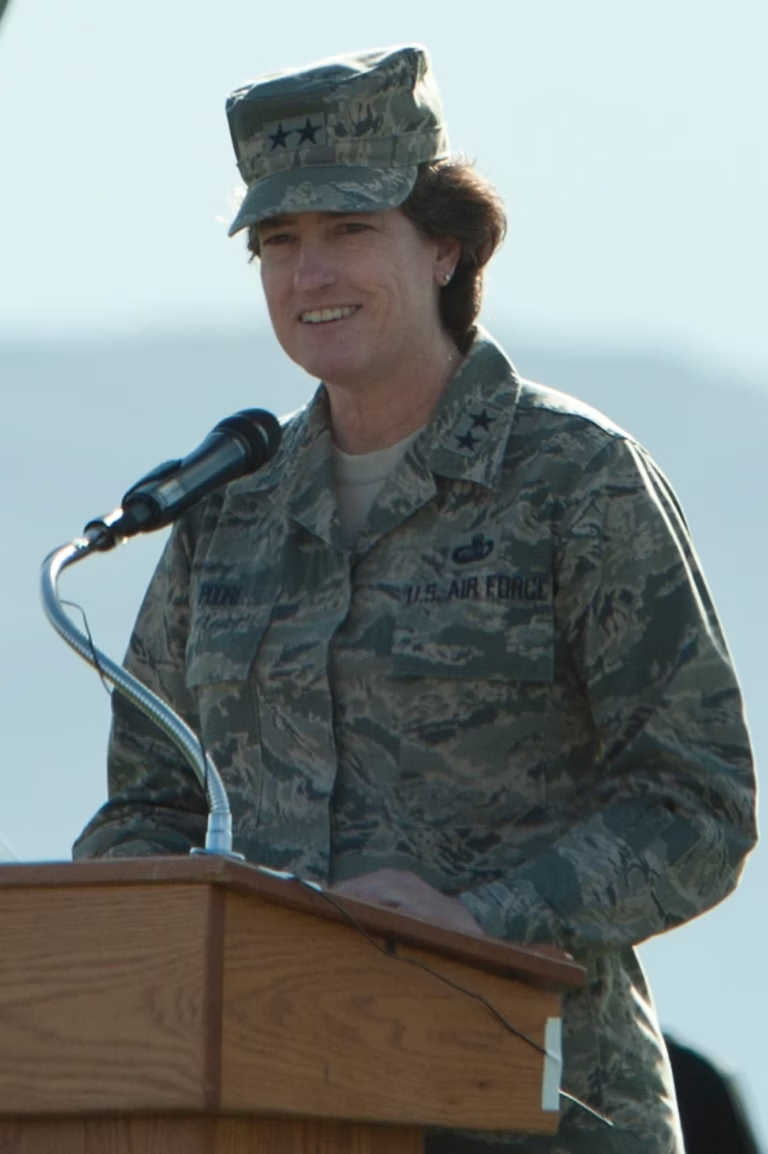
What it means to rise through the ranks & be a true leader with Major General Peggy Poore (Ret.)

Rank is easy to see.
Bars catching light on a collar. Stars fixed to a chest. That subtle shift in posture when someone walks into the room.
It’s visible. Immediate. Hard to miss.
But what it actually represents is a lot less obvious.
Because rank was never meant to signal power. It was built to carry responsibility.
For Major General Peggy Poore (Ret.), that responsibility has stretched across decades—across roles where decisions carried real weight, where leadership shaped outcomes, and where the expectations went far beyond the person wearing the insignia.
But that path didn’t start with rank in mind.
She grew up in a multi-generational military family, where service wasn’t just something you talked about, it was something you lived. It wasn’t about chasing a position. That was never really the point.
It was about stepping into something bigger than yourself.
Doing the job in front of you. And doing it well.
Because what rank looks like—and what it asks of you—are rarely the same thing.

A Brief History of Rank
Long before the modern military, rank existed because it had to.
Early armies—Roman legions, European forces—needed structure if they were going to function under pressure. Orders had to move clearly. Decisions had to be trusted. Responsibility had to be defined before the moment demanded it.
So systems were built.
Centurions. Captains. Generals.
Each tied to a group. Each accountable for an outcome.
Authority wasn’t symbolic, It was practical.
By the time the United States formed its military, it adopted much of that structure—refining it into something designed for clarity and cohesion.
Officers planned and directed.
Noncommissioned officers enforced standards and led at the ground level.
Enlisted soldiers carried out the mission.
Not just hierarchy but alignment.
A way to make sure that when pressure hit, people didn’t operate as individuals—but as part of something coordinated.
When asked about rank today, Major General Poore put it simply:
“It’s a hierarchy and a chain of command, and it’s about authority and responsibility.”
Over time, that structure expanded alongside the complexity of warfare. Operations grew. So did the scope of leadership. Rank began to reflect not just position but reach. Impact. Consequence.
The expectation grew, but the foundation never really changed.
Rank was never meant to elevate the individual.
It was built to define responsibility—clearly, and ahead of time.
What Rank Actually Means
When asked what people misunderstand most about rank, Major General Poore didn’t hesitate:
“Just because you have rank doesn’t mean you’re a leader.”
That gap—between position and leadership—is where everything either works… or doesn’t.
Rank gives you authority. It defines what you’re responsible for.
But it doesn’t guarantee trust.
That part has to be earned.
“I’ve got to earn their respect, and I’ve got to earn the position of a leader.”
And that doesn’t happen all at once.
It happens in the small decisions. In the standards you hold when it would be easier not to. In how you show up—especially when no one is watching.
Rank might place someone in position.
But leadership is what they do once they’re there.


Rising Through the Ranks
Leadership doesn’t show up all at once.
It builds—over time, under pressure, through repetition.
And usually, you don’t notice it happening until the responsibility starts to feel heavier than it used to.
Early on, it’s simple. Learn the standard. Do the job. Prove you can be counted on.
But that phase doesn’t last.
Because as roles change, so does what’s expected of you.
When asked how she approached rising through the ranks, Major General Poore didn’t talk about chasing promotion or position.
She talked about something much simpler.
Showing up.
Doing the job in front of her.
And carrying the responsibility that came with it.
And when asked when that shift really begins, she reframed it entirely:
“It wasn’t really a rank, it was more of the job.”
And that’s the part people often miss.
Responsibility doesn’t arrive with insignia alone. It shows up in what you’re being asked to carry.
And over time, that weight grows.
The mission gets more complex.
The stakes get higher.
And the number of people affected by your decisions expands, often beyond what you can see.
What once was about doing the job well…
becomes making sure others can.
That shift—from execution to multiplication—is where leadership really starts to take shape.
But it doesn’t happen perfectly. At some point, she realized that holding everything to a perfect standard wasn’t just unrealistic—it slowed things down.
Sometimes, 90% was enough.
Not because standards didn’t matter, but because progress mattered more.
Because leadership isn’t about getting everything right.
It’s about knowing when something is strong enough to move forward—and trusting your people to carry it from there.
That lesson became even more real when she stepped into a Group Commander role.
Up to that point, her expertise had been clearly defined—administration, human resources, structured systems she understood.
Then suddenly, she was responsible for areas far outside that.
Security forces.
Fire departments.
Civil engineering.
Communications.
Entire teams of experts—working in fields she didn’t come from.
And that’s when something shifted.
She didn’t need to know everything. She needed to learn to trust the people who did.
Leadership became less about control—and more about creating the conditions for others to succeed.
Providing direction. Providing support. Then stepping back.
Because as responsibility expands, leadership changes.
Not from knowing more—but from knowing when to let go.


The System Behind the Rank
When asked about leadership within the system, Major General Poore pointed to something that often gets overlooked:
“There’s a lot of informal leaders.”
The people who don’t necessarily wear the rank—but shape everything anyway.
The ones who reinforce standards when no one is watching, carry experience forward and influence how a team actually functions day to day.
Formal rank creates structure. But informal leadership is what gives that structure strength.
It’s what builds trust where it actually matters. And it doesn’t always move in one direction.
“They can lead you, guide you, and mentor you, even though… you outrank them.”
That realization doesn’t come automatically.
Earlier in her career, she found herself doing what a lot of driven leaders do—taking on too much. Stepping in when things weren’t done exactly right. Carrying more than she needed to.
Until eventually, it caught up with her.
“I was working myself to death.”
That moment forced a shift.
Because leadership isn’t supposed to be a bottleneck. It’s supposed to create momentum.
From that point on, leadership became less about doing everything—and more about empowering others to do it well.
Guiding when needed. Stepping in when necessary. But mostly—letting people rise to the standard.
And trusting that it didn’t need to be perfect to be effective.


Why Rank Still Matters
In a world that often pushes back on structure, rank can feel rigid.
But in practice, it creates clarity.
It defines responsibility before decisions have to be made.
It removes hesitation when time is limited.
It allows people to act with confidence under pressure.
Without it, even capable teams struggle to move as one.
Structure makes action possible. And within that structure, leadership determines whether it holds.
Major General Poore put it simply:
“You never know what your people are going through. Take the time to find out.”
Because at its core, the system doesn’t run on rank alone, It runs on trust.
And trust is built long before it’s tested.
Closing Reflection
Rank is visible. Responsibility is not.
But behind every insignia is something far more important than authority—
A system built on discipline, accountability and the expectation that someone will step forward when it matters.
And sometimes, the impact of that doesn’t show up right away.
It shows up later.
In the people who come back years down the line—
sharing moments you don’t remember.
Conversations that felt routine.
Decisions that, to you, were just part of the job… but to them, meant something more.
Because leadership doesn’t just shape outcomes, It shapes the people who will continue to shape outcomes.
Quietly. Over time. In ways you don’t always see.
That’s the real weight of it.
Rank may define the position but leadership defines the person.
And as Major General Poore said:
“Just because you have rank doesn’t mean you’re a leader.”
That part is earned.
Over time. Under pressure. And in the moments when others are counting on you most.
Because in the end, rank isn’t about where you stand.
It’s about what you’re willing to carry—
and who you choose to carry it for.
